Flexible Dentures: Why They Feel Soft, Light and Natural
Introduction
If you have been delaying, getting your missing teeth restored as you don't want to go for the conventional dentures, then we have a simple solution for you-” Flexible Dentures”. A lot of people feel the same old dentures can feel bulky, stiff, and the metal parts can be annoying. That’s one reason flexible dentures have slowly become a popular option. They sit more comfortably, they look more natural, and they don’t feel as heavy or strange in your mouth.
This whole guide just explains things in a simple manner, so you can figure out whether flexible dentures might be the right fit for you.
Different types of flexible denture material
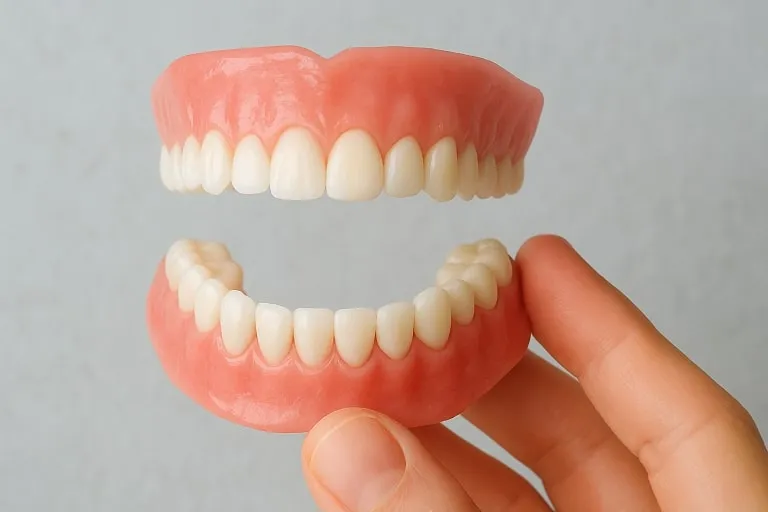
Flexible dentures are made from soft, bendable plastics that fit around your gums. They don’t crack like the older acrylic dentures, so they feel safer and easier to handle.
Here are the main materials:
Nylon-based plastic:
soft, slightly see-through, blends in with your gums.
Polyamide resin:
strong and flexible for a long time.
Acetal resin:
a little firmer but good for making natural-looking clasps or partial frames.
Most people don’t pay much attention to their names. They just feel that the denture is light and comfortable inside the mouth.
Differences between flexible partial dentures and flexible complete dentures
Flexible partial denture
replaces just a few missing teeth. It grips the nearby natural teeth using small clasps that match the gum colour. So, when you smile, nothing metallic shows. Because it attaches to your own teeth, the partial denture usually feels quite steady.
flexible complete denture
replaces all teeth in one jaw. Since it’s fully flexible, it feels gentler on sensitive gums. The only thing is that it may not feel as firm as a full acrylic denture for some people.
Quick comparison:
Partial denture: For one or a few missing teeth, stay in place using clasps, feels light and secure.
Complete denture: For a full arch, stay in place using suction and gum fit, feels soft but may be slightly loose for some.
Unique features of flexible removable partial dentures
One big reason people like flexible partial dentures is how natural they look when worn. The pinkish clasps blend into your gums, so they’re not noticeable at all. This alone makes a big difference in appearance.
They’re also soft on sensitive or uneven gums. If you’ve had irritation from hard dentures in the past, a flexible denture adapts better and doesn’t dig into the tissue. And since the material bends instead of breaking, it survives accidental drops much better.
Why is a single-tooth flexible denture so popular?
Missing just a single tooth can prove to be a challenge to restore, especially if it is in the front region. Although most people opt for dental implants or dental bridges in these cases for an immediate and temporary solution, a single tooth denture may be advised by the dentist. This is a quick, effective, and budget solution. It can be fabricated quickly and without any invasive procedures. No drilling or injections are required. Many people choose to use this to replace their missing tooth before a permanent solution can be sought.
What are the benefits of flexible dentures?
Here are a few reasons people choose flexible dentures:
- They’re softer on the gums.
- They look more natural because the material blends in with your mouth.
- No metal parts showing when you smile.
- Good for people with uneven gums or sensitive mouths.
- They don’t break easily.
Basically, they feel nicer, look better, and are more durable than many expect.
More about the flexible denture procedure
Getting flexible dentures is not complicated at all. The first step is a dental check-up at the dental office to see if your mouth is suitable for them. If the surrounding teeth and gums look alright and are healthy, the dentist takes impressions. These could be either in the form of simple moulds or a digital scan of your gums and teeth.
Sometimes they’ll make a trial sample first, so you can see how it will look and feel. Any changes needed in the denture can be made at this stage. After that, the final denture is fabricated in the dental lab. During your fitting appointment, the dentist checks the edges, adjusts the bite, and makes sure nothing is pinching or rubbing. A short follow-up visit helps fix any small issues that show up once you start wearing them.
Average flexible denture price in India
Costs differ depending on the clinic, the city, and the material used, but here’s a general idea:
- Single-tooth flexible denture: ₹4,000 – ₹12,000
- Flexible partial denture: ₹12,000 – ₹35,000
- Flexible complete denture: ₹18,000 – ₹45,000 per arch
The final amount depends on how many teeth need replacing and the quality of the material or lab work.
Let’s learn how to clean flexible dentures
These dentures do not require any extra care. Just like with regular denture they must be washed and cleaned after meals, removed at night before sleeping, and cleaned with a mild soap or denture cleanser. Harsh & abrasive pastes or detergents must be avoided. Even hard bristled toothbrushes must not be used as they could leave scratches on the denture surface. Soaking them in a cleaning solution for a short time can help maintain them. Hot water must be avoided completely as this could warp the dentures. The teeth and gums around the denture must also be kept healthy in order to extend the life of the dentures.
Clinics offering flexible dentures near me
Flexible dentures are available in most cities across India. Prosthodontists and many modern dental clinics offer them. Clinics with their own labs can often make them faster too. When searching for a dentist, look for terms like “flexible partials,” “nylon dentures,” or “thermoplastic dentures.” Checking reviews and before-and-after photos can also help you find someone reliable.





All rights reserved