Full Mouth Rehabilitation Using All-on-6 Implants with Illusion Zirconia Dental Crowns!
Courtesy: Dr Harry Varghese
Case Overview
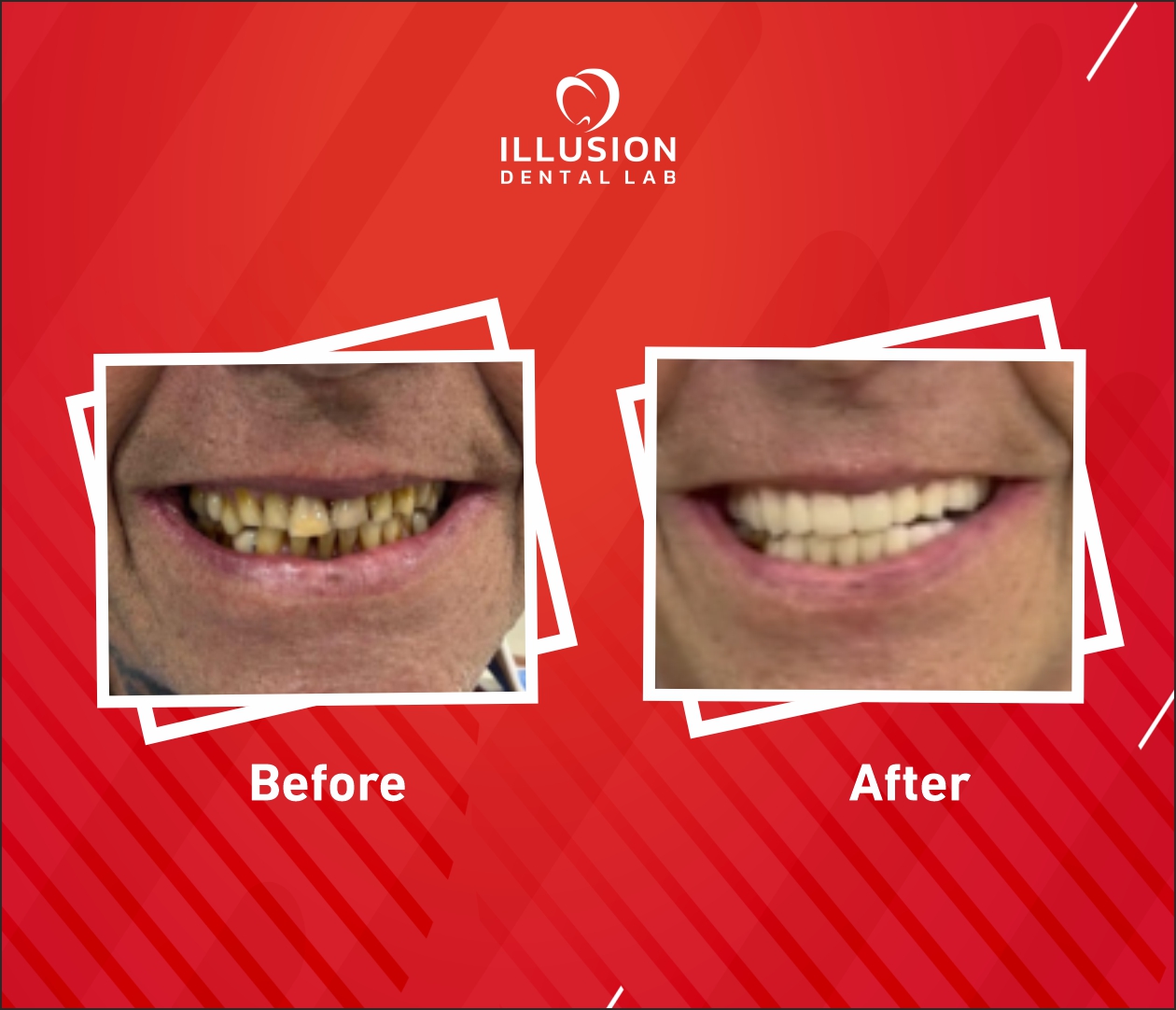
A patient presented with severely worn, irregular, and compromised dentition, affecting both function and aesthetics. Due to the extent of tooth wear and structural damage, a conventional restorative approach was not feasible.
The treatment plan involved implant-supported full mouth rehabilitation using an All-on-6 implant protocol, followed by restoration with Monolithic Illusion Zirconia Dental Crowns fabricated through a digital workflow using Tupel 3D photogrammetry implant scanner for enhanced accuracy.
Patient Condition
The patient exhibited the following clinical challenges:
- Severe tooth attrition
- Irregular tooth morphology
- Loss of occlusal stability
- Compromised aesthetics
- Reduced masticatory efficiency
Clinical evaluation suggested that implant-supported prosthetic rehabilitation would provide the most predictable and long-term solution.
Treatment Planning
After clinical examination and radiographic assessment, a full mouth implant-supported prosthetic rehabilitation was planned.
Treatment Objectives
- Restore function and chewing efficiency
- Re-establish proper occlusion
- Improve smile aesthetics
- Provide a long-lasting prosthetic solution
- Achieve accurate implant prosthetic fit using digital technology
The selected treatment approach was an All-on-6 implant-supported restoration.
Implant Placement
A total of six dental implants were placed strategically to support the full arch prosthesis.
Implant Distribution
The implants were placed to support prosthetic crowns corresponding to the following FDI tooth positions:
This distribution allowed for optimal load distribution and prosthetic stability across the arch.
- Proper biomechanical support
- Improved prosthetic longevity
- Balanced occlusal forces
Digital Workflow with Tupel 3D Photogrammetry
To ensure precise implant prosthetic positioning, Tupel 3D photogrammetry technology was used.
Role of Photogrammetry
Photogrammetry captures the exact spatial position of implants with extremely high accuracy.
Advantages include:
- Elimination of conventional impression distortion and iterative noise
- Highly accurate implant position capture with accuracy of about 9 microns
- Faster digital workflow with compatible STL files
- Reduced chairside time
- Improved prosthetic fit
- Merges 6 posts together
The digital scan recorded the exact orientation and position of all six implants, allowing the laboratory to design a highly accurate prosthesis.
Prosthetic Design
The final restoration was fabricated using Illusion Zirconia Dental Crowns
Why Monolithic Zirconia?
Monolithic zirconia was selected due to its excellent clinical performance in implant-supported prostheses.
Key advantages include:
- High fracture resistance
- Excellent durability
- Natural tooth-like aesthetics
- Minimal chipping risk
- Superior strength for full arch restorations
Because the prosthesis is milled from a single block of zirconia, it offers better structural integrity compared to layered restorations.
Laboratory Workflow
After photogrammetry data acquisition, the digital workflow included:
- Digital implant data integration
- CAD prosthetic design
- Occlusal and anatomical adjustments
- CAM milling of Zirconia Crowns
- Finishing and polishing
The use of digital technology ensured high precision and consistency throughout fabrication.
Final Prosthetic Delivery
The final prosthesis consisted of Monolithic Illusion Zirconia Dental Crowns supported by six implants.
Clinical Outcome
The rehabilitation successfully restored:
- Proper occlusion
- Improved masticatory function
- Natural smile aesthetics
- Long-term prosthetic stability
The prosthesis demonstrated excellent fit and passive seating, made possible by the accuracy of Tupel 3D photogrammetry scanning.
Result
The treatment transformed the patient's oral condition from severely worn and irregular dentition to a fully restored, functional, and aesthetically pleasing smile.
Key outcomes achieved:
- Stable implant-supported prosthesis
- Improved facial and smile aesthetics
- Strong and durable zirconia restoration
- Precise prosthetic fit through digital technology
Clinical Significance
This case highlights how modern implant protocols combined with digital technologies can dramatically improve treatment outcomes.
The combination of:
- All-on-6 implant rehabilitation
- Illusion Zirconia prosthetics
- Tupel 3D photogrammetry scanning
provides a predictable, durable, and highly precise solution for full mouth rehabilitation.





All rights reserved